6th Global
Women’s Empowerment & Leadership Summit
THEME: "Empowering Global Entrepreneurs & Leadership for Tomorrow"
 23-24 Nov 2026
  Holiday Inn Express Bangkok, Thailand
 THEME: "Empowering Global Entrepreneurs & Leadership for Tomorrow"
23-24 Nov 2026
Holiday Inn Express Bangkok, Thailand 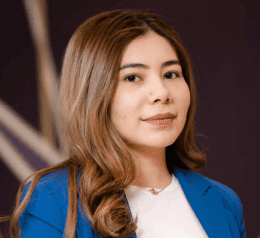
British Management University, Uzbekistan
Title: Proposal by Markhabo Nazarova. Supporting or Constraining? The Impact of State Policies on Women Entrepreneurs in Uzbekistan
Ms. Markhabo Nazarova is a highly skilled legal professional with experience in legal research and practice in various international projects and NGOs. Her latest engagement was with the international project for women empowerment in the Central Asia region.
Ms. Markhabo possesses excellent communication skills and deep knowledge of teaching methodology and has experience in working with different age groups of students with various learning needs and demands. Her ability to deliver information in an interactive, diversified and understandable way is truly impressive. She has advanced legal research skills and an innovative mind that she is very keen to apply to her future academic endeavours.
Ms. Nazarova has received her bachelor’s degree in Commercial Law with First Class Honours and master’s degree in International Commercial Law from Westminster International University in Tashkent.
This paper studies the effect of government policies on the development of women’s entrepreneurship in Uzbekistan, taking as a point of interest the enduring conditions of economic precarity and informality that shape women’s work. In recent years, the Uzbek government has launched various programmes to support the business activity of women, including legal reforms, training and preferential financing schemes. Despite these efforts, many women-entrepreneurs still operate in an unstable environment with limited resources. The paper answers the following research question: to what extent do government policies in Uzbekistan reduce economic precarity among women entrepreneurs, and what are the structural barriers that continue to limit their effectiveness? The study takes qualitative approach using combination of analysis of legislation, policy documents and institutional programmes and grassroots research based on field observations and case-based evidence of women’s entrepreneurial practices at the local level. This methodology makes it possible to consider not only the formal design of support mechanisms, but also the experience, interpretation and negotiation of these policies in everyday economic life. Particular attention is paid to the role of institutional actors, such as government bodies and professional associations, in facilitating access to finance, information and professional networks. The findings suggest that although state policies have increased formal opportunities and brought more women’s entrepreneurship to light, there are still great challenges. Limited access to finance, deeply ingrained social norms and unequal knowledge of available support mechanisms perpetuate conditions of economic precariousness, especially among small-scale and informal entrepreneurs. At the same time, digitalisation, new financial instruments and international cooperation are opening new opportunities that may gradually change the face of entrepreneurship. By analysing the intersection between a policy, legal frameworks and everyday economic practices in a Central Asian context this paper is part of broader discussions about gender, informality and entrepreneurship outside of the global economic centre. It also offers insights that are relevant to policy makers that are looking to strengthen institutional mechanisms to support women’s participation in the economy.
Key Themes and Questions:
1. Do government policies help to effectively reduce economic precarity for women entrepreneurs?
2. Why do informal or semi-formal business practices continue to exist in spite of policy reforms?
3. How do women's economic participation change according to cultural norms and social expectations?
4. What role do institutions, networks and grassroots play in supporting women entrepreneurs?
5. How does digitalisation change possibilities and dangers for the business of women in the emerging economy?
Relevance to GWO and 2026 Conference Theme:
This study relates directly to the central issues of Women’s Empowerment & Leadership Summit in its study of the gendered aspects of entrepreneurship, precarity and institutional change. It feeds into the current debates on informality, resiliency and women's work beyond the dominant western contexts. By paying attention to the interplay between policy frameworks and the practices of everyday life, the stream offers new empirical and conceptual understanding of how structural inequalities are sustained despite the presence of formal mechanisms of support. The geographical focus on emerging and transitional economies, especially Central Asia, helps to widen the regional scope of existing scholarship and fits very well with the emphasis of this conference on diverse and underrepresented contexts.
Planned Format
The research is intended as a series of paper presentations in combination with moderated discussion. Each session will include time for questions and collective reflection in order to encourage discipline and region-crossing dialogue. Where appropriate there might also be short thematic panels to facilitate comparative discussion between different country contexts.
